2. Main Contents
Dr. Coley began treating cancer patients with pathological bacteria 130 years ago with astonishing success and then published his experiences. His successors also published similar publications later on. You can find more about the history of such treatments and other case studies here.
| [2] | Micksche M., Kokoschka E M, Sagaster P, et al. Klinische und immunologische Untersuchungen mit OK-432 (Streptococcus pyogenes) zur Immuntherapie bei Krebspatienten. Onkologie, 1978; https://doi.org/10.1159/000213929 |
[2]
.
All of this was not so long ago. In 1978, an article from Vienna in the journal "Oncology" stated that "immunotherapeutic methods have contributed significantly to the enrichment of conventional forms of cancer therapy in recent years."
| [3] | Schorr-Tschudnowski M. Konzept einer komplexen Tumortherapie mit kurativem Anspruch auch in fortgeschrittenen Stadien. Erfahrungsheilkunde, 2023, https://doi.org/10.1055/a-2107-7158 |
[3]
.
All such observations, isolated experiments, and experiences with immunotherapy have almost been forgotten with the widespread introduction of chemotherapy. After that, the conservative treatment spectrum relied solely on chemotherapy and radiation, which actually have little to do with the complex processes in the human body during cancer.
A long-desired breakthrough in tumor treatment only came about after I became familiar with PAMP-therapy. PAMP is an abbreviation for pathogen-associated molecular patterns.
Various preparations are used as PAMPs, primarily vaccines made from live, weakened bacteria and viruses. The best bacterial PAMP preparations are probably StroVac and Picibanil. Gynatren can also be used for this purpose. Of the viral vaccinations, I mostly use the flu vaccine and the combined vaccine against measles, mumps, and rubella. Measles viruses have long been recognized in research as well-suited vectors for guided cancer immunotherapy due to their high genetic flexibility.
.
PAMPs act via receptors on immune cells such as Toll-like receptors (TLRs), whose function is to recognize molecules from pathogens such as bacteria, viruses, or altered cells. These receptors, of which 10 different TLR subtypes have already been identified, then initiate a strong defense reaction, which is one of the oldest epigenetically speaking components of the immune response.
PAMP-therapy, currently used by some colleagues for immune simulation, was researched, updated, and systematized by Prof. Uwe Hobohm of the University of Giessen. His first article on the subject was published in 2008.
.
The PAMP preparation that I use most often is StroVac, because there are different bacteria in the ampoule - Escherichia coli, Morganella morganii and Proteus mirabilis.
Picibanil is also good for this. It consists of a special strain of Streptococcus pyogenes, but should be ordered from an international pharmacy. PAMPs are always used with mistletoe extracts (Viscum album) 20 mg one ampoule as a booster.
Here one must not forget. Aluminium is still used as a booster in many vaccinations and it is very possible to become intoxicated with aluminium after prolonged treatment. This is also the case in StroVac. I therefore do not use the enclosed ampoules as a solvent, but simply 0.9% NaCl.
It is recommended to carry out a tolerance test before starting PAMP therapy. I can hardly imagine an intolerance reaction to bacteria or viruses, but this recommendation exists. For the testing of mistletoe preparations, such a recommendation is much better founded.
I always start with small doses. For example, 0.03 ml StroVac with up to 0.5 ml of Iscador as a small infusion in 100 ml NaCl, which usually does not trigger a significant reaction, and then I gradually increase the dose until the desired reaction is achieved. Which means: after about 40 to 60 minutes, chills start, then fever rises to 39 degrees or a little higher, which slowly goes down over the next few hours. I then stick to this dose at first and may change it slightly depending on the reaction. Incidentally, this reaction also occurs with the same dose and is not always equally pronounced in the same patient.
A normal reaction is one in which the body temperature normalises after 6-8 hours. As the immune system is dysregulated in many patients, it is not uncommon for the initial reaction to take significantly longer, can be bicuspid, and sometimes it can even take up to 24 hours for the temperature to fully normalise. The next day, the patient may feel a slight weakness, as after surviving a minor viral infection.
After a few months of PAMP-therapy, the fever duration usually shortens to 5-6 hours.
The frequency of treatment—two or three times per week—will depend on this response to PAMP-therapy, as well as the general condition and initial state of the immune system.
During treatment, one not only sees an improvement in laboratory values and stabilization of tumor growth, but also the shrinking of tumors and metastases, and usually their disappearance. If the treatment progresses well, this shrinkage continues until the lesion is no longer visible. Practical experience confirmed my original assumption that the entire therapy should be continued for at least another three months before daring to reduce the intensity of treatment or discontinue PAMP-therapy. I must say that this is the most difficult and uncertain stage of the entire treatment. Unfortunately, it is always an intuitive decision, which one arrives at by observing the patient and their disease progression over several months during treatment.
This final, intensive phase of treatment is difficult for the patient because, understandably, they've already developed a certain degree of treatment fatigue. On top of that, they hear congratulations from radiologists and oncologists about the tumor disappearance or even a cure. That's why I talk to patients about it early on, rather than just once, to explain that initially, it only means that the remaining tumor tissue has become less than 3 mm. That it's still only a matter of macroscopic tumor clearance. Therefore, they still need some courage and patience.
Understandably, maintenance therapy remains a must for a very long time afterwards. Otherwise, an immune system that has failed once may do so again at some point.
There is a funny but important moment at the beginning of the imaging checks. All patients are impatiently waiting for some kind of data that will tell them whether the treatment is helping or not. An improvement in the blood count or falling tumour markers are usually not enough and they repeatedly ask when they should have a CT/MRI scan. I in turn say right from the start that these examinations are not permitted in the first three months. I also explain why.
After a few weeks of active immunological therapy, the tumour is infiltrated with a large number of immune cells, both in the depth of the tumour and even more in the layers near the surface. If the examination is carried out after just 4 weeks, an obvious enlargement of the tumour can be seen. You can imagine the patient's reaction. That is why I do not allow such premature examinations. Incidentally, this phenomenon of effective immunotherapy is known as “pseudoprogression” and is associated with improved response to treatment.
| [6] | Balar A. V., Galsky M. D., Rosenberg J. E. et al. Atezolizumab as first-line treatment in cisplatin-ineligible patients with locally advanced and metastatic urothelial carcinoma: a single-arm, multicentre, phase 2 trial. Lancet. 2017, https://doi.org/10.1016/S0140-6736(16)32455-2 |
[6]
.
There are two ways of carrying out PAMP therapy. In most cases, the PAMP preparations with mistletoe are given as a 30-minute infusion. The rise in temperature after the chills can be accompanied by flu-like symptoms, nausea or slight fluctuations in blood pressure.
The second option is to inject PAMP with mistletoe, where possible, directly into the tumour tissue or very close to it. I find that the second option has a much stronger effect. This is actually not surprising, as in this case a very strong, relatively localised inflammation causes a massive activation of all immune cells at the site. Such an inflammatory reaction triggers a powerful flood of pro-inflammatory cytokines, which obviously have a stronger effect than the inhibitory cytokines in the tumour microenvironment. Undoubtedly, dormant lymphocytes infiltrating the tumour tissue are also activated.
In addition, a fairly large number of fragments of damaged tumour cells immediately enter the bloodstream, where they encounter an immune system that is already stimulated by the remnants of the tumour cells. It is known that scraps of the tumour's own cells in the blood cause even the weakened immune system to become particularly agitated.
This experience of mine was recently confirmed by the virologist Beata Halassy, who cured her breast cancer herself with local injections of oncolytic viruses,
| [7] | Forcic D, Mrcic K, Peric-Balja M. et al. Eine unkonventionelle Fallstudie zur neoadjuvanten Onkolytika-Virotherapie für wiederkehrenden Brustkrebs. Vaccines 2024, https://doi.org/10.3390/vaccines12090958 |
[7]
.
My experience also shows that you should not necessarily only use special, expensive oncolytic viruses for such a therapy.
Vaccines made from live, attenuated bacteria and viruses also ensure sufficient and successful activation of the immune system.
For local infiltration, I usually initially use up to half a dose of what is administered intravenously with an additional 0.5 ml of procaine. Further doses are decided on the basis of the reaction.
Although the body temperature usually only rises to approx. 37.5 after the intra- or paratumoral injection, in addition to moderate pain at the injection site, chills and nausea are also possible.
All patients should have paracetamol, anti-nausea medication and, in the case of injection therapy, a painkiller at home.
My condition for carrying out PAMP therapy is to have an accompanying person to take the patient home after the treatment and to stay with them for at least the first 6-8 hours.
As already mentioned, the bacteria and microbes used for immune activation are called PAMPs.
The various endogenous activators circulating in the blood that emerge from damaged tissues or are fragments of tumour cells are called DAMPs (Danger Associated Molecular Patterns). These are usually referred to as tumour antigens. PAMPs are therefore exogenous and DAMPs endogenous immune stimulators.
The aim of PAMP therapy is to generate such an immune response, which subsequently leads to the destruction of some tumour cells. As a result, the DAMPs enter the bloodstream, where they represent danger-associated molecular patterns for the immune system, which are then specifically sought and destroyed. If the immune system does not yet recognise the antigen, the IFN-γ will trigger a series of immune reactions. The cell tries out various weapons to combat the antigen. Once the cell has successfully combated the antigen, IL-12 begins to take effect. It causes the cell to memorise the last reaction to the pathogen that was successful.
It also affects the NK cells. It has been proven that NK cells react much faster to repeated infections, meaning that the innate system is able to learn more than expected.
| [8] | Torcellan T, Friedrich C, Doucet-Ladevèze R. et al. Circulating NK cells establish tissueresidency upon acute infection of skin and mediate accelerated effector responses to secondary infection. Immunity. 2024, https://doi.org/10.1016/j.immuni.2023.11.018 |
[8]
.
It has long been proven that the activating effect of peptides on the immune system depends on the dosage, timing, and the patient's initial immunological status. These factors determine whether the immune response is stimulated, regulated, or remains largely unchanged.
| [9] | M. Dabrowski, B. Dabrowski-Bernstein: Immunoregulatory Role of Thymus, CRC Press 1990, S. 154. |
[9].
In order to assess the general state of the immune system as a whole, the immune status should be determined prior to therapy. However, determining the number of natural killer cells (NK) and cytotoxic T cells (Tc cells) alone tells us nothing about their ability to kill the altered cells. I also make sure to measure the activity of natural killer cells with a functional test. With these results, we also have the baseline values for subsequent monitoring.
Tumor cells, like all living beings, want to survive and defend themselves. Cancer cells are by no means isolated in the body. They interact with the adipocytes, fibroblasts, endothelial cells, and, of course, immune cells present in the microenvironment by altering the composition of cytokines and chemokines in the tumor mass. As a result, tumor cells alter their activity and functions in their microenvironment and in the immune cells present in the tumor tissue to their own advantage.
The entire tumor metabolism is involved in such escape mechanisms against immune cells. Such regulatory disturbances represent the main problem in tumor treatment.
The same thing happens during metastasis. Before a migrating tumor cell can develop into a metastasis after dissemination, it must establish numerous molecular interactions with its new environment. To survive and establish itself in this new environment, the cancer cells first prepare their tumorigenic microenvironment. The tumor cell thus creates a so-called "metastatic niche." Even the non-malignant cells in its surroundings often exhibit a tumor-promoting function at all stages of carcinogenesis.
| [10] | Hongu T. Pein M., Insua-Rodríguez J. et al.: Perivascular tenascin C triggers sequential activation of macrophages and endothelial cells to generate a pro-metastatic vascular niche in the lungs. Nat Cancer, 2022; https://doi.org/10.1038/s43018-022-00353-6 |
[10]
.
As it would be naïve to believe that a disease as complex as cancer can be defeated with just a few drugs, I have always tried to "fire from all cylinders". In addition, one should always remember that any effective anti-cancer therapy exerts a strong selection pressure on the tumour and biological therapy is no exception in this respect. This applies more to advanced cases, but it is always important to remember this. Every new possibility to strengthen the therapy or to change it in an equivalent way is at the same time a means of blocking the tumour's possible mutation pathways.
Understandably, the first thing that came to my mind when it came to boosting PAMP therapy was checkpoint inhibitors (ICI). It is logical that a strongly stimulated immune system will work even more effectively if we weaken at least one of its brake pedals.
It is now known that the action of various chemotherapies involves the stimulation of anticancer immunity, either by initiating the release of immunostimulatory molecules from dying cancer cells or by mediating off-target effects on immune cell populations.
.
This confirms and experience that chemotherapy can transform so-called immunologically "cold" tumours into immunologically "hot" ones. It took about ten years for even stubborn chemotherapy supporters to realise that the simultaneous administration of standard chemotherapy and immunomodulators can prolong survival by several months compared to administration one after the other.
These immunomodulatory mechanisms underlying the efficacy of chemotherapy have the potential to accelerate the development of synergistic combination therapies that could significantly improve clinical effects. Chemotherapy induces immunogenic cell death. This does not require the usual doses of chemotherapeutic agents. Much smaller doses should be sufficient to achieve the desired amount of antigen.
In order for the entire immune system to attack a tumour, it must be damaged in such a way that it releases DAMPs, whereby the immune system is directed quite specifically at the existing tumour.
It therefore essentially always depends on whether there are sufficient tumour antigens in the blood as targets for immunological cells and whether these cells show an increased readiness to attack, which is always the case after PAMP therapy.
The ability of toxic chemotherapeutic preparations to produce DAMPs has even been somewhat researched. The highest overall response rate was found when checkpoint inhibitors were combined with doxorubicin (35%), followed by cisplatin (23%).
| [12] | Sharma P, Stecklein SR, Yoder R et al. Clinical and biomarker results of neoadjuvant phase II study of pembrolizumab and carboplatin plus docetaxel in triple-negative breast cancer (TNBC). Journal of Clinical Oncology, 2022, https://doi.org/10.1200/JCO.2022.40.16_suppl.513 |
[12]
I mostly use doxorubicin, except for those cancers where other chemotherapeutic agents are known to have a much stronger effect.
Since PAMP therapy strongly activates not only the immune system but all systems of the organism, both checkpoint inhibitors and toxic chemotherapeutic agents should not be used in full doses. Otherwise the damaging effect of chemotherapeutic preparations will be too pronounced and, understandably, autoimmune side effects of ICI will occur quickly and severely.
The doses used were initially a half-dose and are now 30 to 40% of the recommended doses, but the chemotherapy preparations should still be administered with the prescribed concomitant medication.
It must be emphasised here that with such a strong activation of the immune system, all known side effects can still occur despite the use of very small doses of immunomodulators. This also applies to chemotherapeutic preparations. Therefore, as stated in the guidelines, close monitoring of recommended blood values should be carried out.
Gemcitabine was the next chemotherapeutic preparation to be included in the complex.
Available data indicate that treatment with gemcitabine can also promote the activation of naïve T cells and does not have an immunosuppressive effect. It may also enhance responses to certain vaccines or immunotherapies.
.
Prof Hajto has pointed out that gemcitabine can increase the expression of stress molecules on tumour cells, which in turn makes these cells much more noticeable to the NK cells.
| [14] | Hajto T. New Perspectives to Improve the MHC-I Unrestricted Immune Mechanisms against Malignant Tumors. Adv Clin Transl, 2018; Res 2: 100014. |
[14]
Of course, no more than half the dose of gemcitabine is administered.
Incidentally, infusions of 60-90 g of vitamin C about 1-2 times per week have a very similar effect, provided that the G6PD status is normal.
We must finally abandon the old idea that it is possible to destroy all tumour cells, even at a widespread stage, with the help of chemotherapy consisting of just a few preparations. The task of chemotherapy in my treatment complex is to supply the immune system with sufficient tumour antigens and at the same time not to suppress this immune system too much, which inevitably always happens with full doses.
After about two years, the possibilities of this complex therapy have become reasonably clear to me.
As is well known, the prognosis for patients with a dozen or more scattered metastases is poor. In such people, both the immune system and often the entire organism are already significantly weakened by the tumor and the preceding therapies.
Unfortunately, in most such cases, we don't have a strong "fighting partner" that we could sufficiently activate. NK function testing plays a very important role here, too. NK are also very important to us because cellular immunity already provides rather poor support.
The problem with cellular immunity in advanced cases is the fact that, in order to protect themselves, tumor cells, once they reach a certain tumor size, increasingly begin to no longer express MHC-1. This makes them undetectable to the presentation cells of the adaptive immune system, which is why the killer cytotoxic T cells are not activated.
However, this theory is probably not entirely correct. If only MHC-1 plays a crucial role in cellular immunity, it is not possible to explain why ICIs have been proven to be effective even in advanced tumors. Most likely, this positive effect is due to other MHC classes. MHC-II is located primarily on dendritic cells, which recognize fragments of bacteria and tumor cells and activate T cells.
MHC-III contains signaling molecules for tumor necrosis factor-alpha, which initiates apoptosis and senescence of tumor cells.
The natural killers of our innate immune system are able to recognize tumor cells even without the MHC-1 marker. NKs work nonspecifically and quickly against all altered cells in the body - the first line of defense. NKs secrete perforins, which are stored as granules within them. After injecting NK-toxic granules into the cancer cell, it dies within minutes, and NK continues to dock onto the next cancer cells. The amount of these killing granules increases with NK activation.
As the tumor disease progresses, they are increasingly downregulated by the cytokines produced by tumor cells, but are never completely eliminated.
Even after invading solid tumours, NK lose the ability to release activating signalling proteins such as chemokines, cytokines and granzymes and go into a kind of dormant state. A strong immune response such as that achieved with PAMP-therapy can significantly activate even dormant infiltrating tumor NK and Tc cells.
| [15] | Dean I., Colin Y. C., Zewen K. T. et al. (2024) Rapid functional impairment of natural killer cells following tumor entry limits anti-tumor immunity. Nature Communications, https://doi.org/10.1038/s41467-024-44789-z |
[15]
.
In patients with numerous metastases, the growth of individual lesions may slowly resume after 6-8 months of treatment. In this case, such a patient has nothing to lose. The doses and frequency of immunomodulators and chemotherapy are slightly increased or changed if necessary. PAMP-therapy is also performed more aggressively. If no increase in the number of natural killers and only a slight increase in their activity is observed after three months of treatment, the prognosis is poor. However, if some of the tumour cells are successfully killed by chemotherapy, radiotherapy or PAMP therapy and the tumour cell fragments enter the bloodstream, this triggers the strongest alarm for the even weakened immune system and activates the immune system in such a way that it can break through the various protective mechanisms built up by the tumour. The natural killers activated in this way then produce various cytokines, which increase both the production of NK itself and its activity. The T cells are also triggered in the process.
Unfortunately, in advanced cases with a few dozen or more metastases of different sizes, even my approach rarely works. Nevertheless, it is sometimes possible to stop the progression of the disease for a certain period of time and in any case to significantly slow down tumour growth. Understandably, success is extremely dependent on the initial situation.
If a patient has a break for any reason, I do not take a full break from PAMP therapy, as Professor Hobohm recommended. Even in the period of 1 to 3 weeks, which I call a break, PAMP therapy is continued once a week to maintain the activity of the immune cells. During these breaks, patients also take BioBran (MGN-3) in addition to PAMP and the next day.
Today, more and more attempts are being made to use combinations of checkpoint inhibitors from both groups. The results are mostly positive but vary. However, it is astonishing how checkpoint inhibitors, which should facilitate the work of the immune system, are widely used today without anyone taking at least some interest in the initial state of the immune system. Let alone not to activate the defence system in addition to the therapy used.
I have been using such combinations for several years. They were given in small doses, usually one third of the recommended doses.
I also wanted to check the benefits of radiotherapy for my treatment. It is already known that radiotherapy can also reduce tumour growth outside the radiation field, i.e. without radiation-mediated direct cytotoxic damage. This phenomenon is known as the abscopal effect.
It was later shown that the release of tumour antigens also increases T-cell infiltration in the non-irradiated tumour sites, which clearly indicates a reaction of the immune system.
I was of the opinion that stereotactic, i.e. targeted hyperfractionated radiotherapy with fairly small daily doses should be preferred to chemotherapy, as the effect is even better and the main general reactions or damage are usually less severe.
Unfortunately, the reality was different. Three facts are problematic with such radiotherapy. Radiologists usually only agree to radiotherapy according to guidelines or with a full dose and therapy lasting more than a month.
The main problem is that tumour cells only start to die after about 6-8 weeks following radiotherapy.
I understandably don't want to wait 6 weeks for tumour antigens. Worse still, combining radiotherapy with PAMP therapy 1-2 times a week significantly increases the side effects of prolonged radiotherapy. That's why I hardly ever ask radiologists for radiotherapy nowadays.
However, studies were presented at the last ASCO congress where the results of hypofractionated radiotherapy of 25 Gy in 5 fractions and even radiotherapy with only three sessions of 8 Gy each were administered in a complex parallel to the chemotherapy already in progress.
| [16] | Erqi L. Pollom, George A. Fisher Jr., Andrew Shelton et al. Phase II trial of organ preservation program using short-course radiation and FOLFOXIRI for rectal cancer (SHORT-FOX). 2024, ASCO Annual Meeting I, https://doi.org/10.1200/JCO.2024.42.16_suppl.3600 |
[16]
That would have suited me quite well.
I would like to give an example of a patient for whom almost all of the options I have mentioned were used.
1. Case report 1
Female patient born in 1977, found a small lump in her right breast herself at the beginning of 2020. The findings were followed by an examination and surgical removal of the tumour in March 2020. All lymph nodes were normal. The patient declined the offer of chemotherapy.
She presented to me in February 2022 as she was experiencing pain in her right breast, where several lumps were palpable. I recommended that she see her oncologist as a matter of urgency. However, the biopsy carried out later did not reveal any suspicion of malignancy.
After a year, she came back for advice on how to proceed. After seeing the breast, I asked her to go to the breast centre as soon as possible and have the breast removed, despite the negative histology result at her place of residence.
She only came back after 7 weeks. The CT scan with contrast from 28 April 2013 showed a mass 7 x 5 cm in the right breast with suspected infiltration of the thoracic wall. On the left side there are several diffusely distributed foci up to 2 cm in the mamma. Malignancy-typical enlarged lymph nodes on both sides of the axilla, as well as on both sides supra- and infraclavicularly and in the lateral triangle of the neck on the left.
Diagnosis: A huge recurrence on the right, with a separate focus in the left breast, extensive lymph node metastasis on both sides of the axilla, supra- and infraclavicular with a diameter of up to 2.4 cm.
The lady was told at the breast centre that there was no point in operating on her as she would die from her metastases anyway. When the patient began to insist on the operation, she was reluctantly offered a few cycles of chemotherapy. If the tumour shrinks significantly, surgery can be discussed again.
She went to the university hospital with the request for a second opinion, where she was also told that she was incurable. The histological examination there confirmed that she had a BRCA1 mutation and that the tumour was triple-negative.
We know that triple-negative breast cancer is a very aggressive tumour. On the other hand, such a tumour has the highest immunogenicity of all breast carcinomas.
That was the initial situation. I informed the patient and said at the end, as always, that we would try to help her and see how she responded to the therapy.
PAMP therapy was started on 10 May. Blood values at the beginning showed weakened NK cell function, but this was not yet as strongly suppressed as in patients who had already been classically pre-treated, where baseline activity is usually 1.5 to 5. The stimulation capacity of NK was also low.
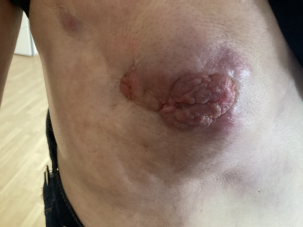
Here is the picture of the initial situation. (
Figure 1).
Figure 1. Before starting treatment.
Patient got her list of capsules for intake, once in four weeks infusion with a half dose of checkpoint inhibitor Nivolumab. Prior to PAMP therapy, 60 mg curcumin was infused each time. Three times in the first 5 weeks, PAMP was also administered as an intra- and paratumo-ral injection. She received 40 mg gemcitabine once during this time.
After 5 weeks, the breast looked much better, which also gave the patient some hope after everything her oncologist had told her.
As no autoimmune reactions had occurred by then, a second immunomodulator was introduced at a quarter dose - Ribociclib.
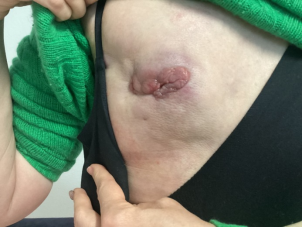
This is how the breast looked after 5 weeks of therapy (
Figure 2) and I asked the radiologists to irradiate the breast while sparing the chest cavity.
Figure 2. After 5 weeks of treatment.
Before that, an MRI scan was carried out on 7 July.
As is always the case, different metastases do not react in the same way and at the same time to the therapy. From the findings it can be seen that metastases on the right and in the neck have become insignificantly smaller - "no relevant change in size", whereas on the left the following was described: "Partially significant regression in size of the axillary lymph node metastases. Exemplary with an extension of 0.9 x 0.7 cm, compared to previously 1.1 x 1.0 cm".
It should be pointed out here that the previous CT scan from 21 June 2013 was available for comparison, which therefore only took place two weeks or 16 days ago.
The patient was started on hyperfractionated stereotactic radiotherapy with doses of 1.8 gr per session. During radiotherapy, she received PAMP therapy twice a week with slightly reduced doses.
The patient only received about two thirds of the planned radiotherapy because the side effects that appeared, such as severe diarrhoea and constant high fever, took a lot of energy. As long as there was a fever, we refrained from PAMP therapy.
So the therapy continued in a somewhat weakened form for a few weeks and then, after a two-week break, she underwent a bilateral mastectomy on 20 September.
Postoperative tumour stage: T4c N1 M1, Ki67 70%.
The complex therapy was continued after three weeks.
In the CT performed on 7 November, no pathologically suspicious lymph nodes were found anywhere.
There was now a stable, good NK cell function in the blood. Also interesting was the very high number of T-cell NK - cytotoxic T-cells, which have already been well activated. Very important for the therapy was the comparably low number of regulatory, i.e. inhibitory, T cells.
Further therapy was possible without checkpoint inhibitors, as the patient had developed pronounced autoimmune thyroiditis with TSH above 100, which is why substitution with 77.5 mg L-thyroxine was started. As always with such NW, things slowly improved. The blood test on 07.02.24 revealed TSH 3.67 mlU/L.
By the end of February, several additional PAMP infiltrations were carried out in the thoracic and intercostal regions on the right, where the distance to the resection line from the edge of the tumour was less than 1 cm.
The patient returned to the south, where she usually lives, and is now considered cured.
My experience shows that a disease with oligometastasis, which is usually defined somewhat inconsistently by the presence of one to five metastases, can usually be cured.
According to estimates in the specialist literature, oligometastatic disease accounts for up to 20% of all metastatic breast cancers at the time of diagnosis. This means that patients with up to 4-5 metastases alone can represent a large field of activity with mostly curative results for this complex therapy. I count as oligometastases those that could not be surgically removed.
I would like to say that for this complex therapy with a well-activated immune system in combination with non-aggressive chemotherapy or targeted short radiotherapy, tumour histology and mutational differences are of secondary importance.
Of course, this fact in no way precludes the additional use of customised targeted preparations. Comprehensive molecular diagnostics will soon be a must. Every targeted preparation can contribute to the healing effect.
Now one more case example, which I have chosen because it shows that the activated immune system can also recognise and destroy its own cells that have become malignant.
2. Case report 2
Patient aged 76, had a left hemicolectomy 6 years ago due to a tumour. He is active and in good general health. About 4 months ago, he had slight hot flushes at night with some sweating and in February 2023 a rutin blood test revealed slight anaemia. Blood in the stool was ruled out and after two weeks there was no anaemia in the blood. In May, however, slight tiredness and diarrhoea were added. Slight anaemia was back. Colonoscopy was unremarkable. CT scan was postponed for family reasons and not done until the end of June. CT showed multiple and enlarged retroperitoneal lymph nodes, especially directly caudal to the right diaphragmatic leg, reaching axial diameters of up to 3 cm. There were also isolated pathologically enlarged lymph nodes in the pelvis. Diagnosis - non-Hodgkin's lymphoma. Diagnosis after subsequent biopsy was: Follicular lymphoma with predominantly diffuse growth pattern.
Oncologists labelled the lymphoma as indolent. The recommendation was, as always in such cases: Wait and start therapy only when growth accelerates. The patient, however, felt that his general condition was clearly disturbed by the tumour and didn't want to wait too long for treatment. He then came to me and we discussed everything, after which he decided in favour of my treatment. He was given a list of the biological preparations and how he should take them. As lymphoma is an inflammation-dependent and self-inflammatory tumour, the patient was also given substances that reduce the expression of pro-inflammatory cytokines such as IL-4, IL-6 and tumour necrosis factor-alpha. These were green tea, alpha-lipoic acid, garlic and slightly more zinc and especially selenium than usual. As the patient had improved overall after taking all the capsules for three weeks, he did not want to miss out on a long-planned trip in August. He was therefore prescribed additional BioBran for the travelling period and until his departure he received one half dose of Gemzitabine and one half dose of Rituximab at two-week intervals. Active treatment was not started until 15 September. Everything as usual - small doses and somewhat less frequently than recommended:
(1) Once in 5 weeks antibody preparation Rituximab initially 50% of full dose, then increase to 80 per cent.
(2) Half of the doxorubicin dose once in 5 to 6 weeks - later 40% of the full dose.
(3) Once in 4 - 5 weeks 40% of PD-1 inhibitor nivolumab.
PAMP therapy was administered twice a week - more was not possible due to lack of time. In addition, his NK function was still only moderately suppressed.
The first CT scan took place on the first of December. The findings stated: "Previously known soft tissue proliferation on the right, below the diaphragmatic leg with significant decrease in size over the course of the examination; the maximum size in the preliminary examination 2.9 x 4.3 cm, currently 1.5 x 1.8 cm. Other retroperi-toneal lymph nodes also show a significant reduction in size. Significant decrease in size of inguinal lymph nodes, for example on the right from a size of 2.1 x 1.1 cm to 1.6 x 0.5 cm.
I have to admit that the result was also somewhat surprising for me. Roughly speaking, pathological lymph node packages have become about 70% smaller.
On the pictures you can see the largest package of lymph nodes, which was under the diaphragm. On the left is the image at the time of diagnosis and on the right is the residual tissue on the first December. It is actually about the result after about 3 months after the start of intensive therapy.
On 20 December, pronounced neutropenia with fever and weakness developed. Patient was hospitalised and treated for 5 days with antibiotics and injections of colony-stimulating factor. The opinion of colleagues was that it was a consequence of doxorubicin, which at that time was administered three times only in doses of 30 and 50 mg, which was actually one third and one half of the full dose.
We then skipped one infusion and it wasn't until 3 February that he received Doxorubicin again - 40% of the full dose for the last time. Everything else went as before.
The last infusion with Rituximab was at the end of February.
On the first of March, another CT scan was performed, which showed no further significant reduction in size. As the contrast accumulation had decreased even further, the radiologists asked whether there was any living malignant tissue at all. Their recommendation was to carry out another check-up in three months as a precaution.
Active therapy lasted until mid-April 2024, after which, as is the case for everyone, peroral maintenance therapy will be given.
The check-up on 19 June revealed further major regression and shrinkage of the residual tissue.
The density values, which depend on the accumulation of contrast, have also continued to fall. The initial density was 80 units (Hounsfield unit). In the residual findings, the density was 28 at the upper normal limit of 50.





 Share This Article
 Twitter
 Linked In
 Facebook
 Copy
Copy Download