
 ,
Azandjeme Colette,
Adegbite Romeo,
Olofindji Jennifer,
Aguemon Badirou
,
Azandjeme Colette,
Adegbite Romeo,
Olofindji Jennifer,
Aguemon Badirou
Introduction: Monkeypox is a re-emerging viral zoonosis that poses a serious threat to public health, particularly in West Africa. A precise understanding of the Knowledge, Attitudes, and Practices (KAP) of the population is essential for designing effective community-based responses. This study aimed to assess the level of KAP in the population and to identify factors independently associated with good KAP. Methods: A cross-sectional, descriptive, and analytical study was conducted in Tchaourou and Parakou, in the Borgou department of Benin, between February and April 2025. A total of 427 people were included. Cumulative scores for knowledge, attitudes, and preventive practices regarding monkeypox were calculated. Three linear regression models were used to identify factors associated with good knowledge, attitudes, and practices. Results: Mean score of knowledge was 56.0%, mean score of attitude 67.0%, and mean score of practice only 44.3%. Factors significantly associated with an increase in the level of knowledge were higher education level (coefficient = 3.22; 95% CI: [1.98; 5.24]) and access to media (coefficient = 1.95; 95% CI: [1.19; 3.21]). Positive attitude was related to good knowledge (coefficient = 1.88; 95% CI: [1.26; 2.80]) and age (coefficient = 1.65; 95% CI: [1.09–2.50]). Regarding good practices, a positive attitude (coefficient = 2.85; 95% CI: [1.97; 4.13]) and female sex (coefficient = 1.62; 95% CI: [1.11; 2.37]) were significant predictors. Conversely, being a farmer/livestock breeder (coefficient = -0.35; 95% CI [-0.74; -0.22]) and living in a rural area (coefficient = -0.59; 95% CI [-0.81; -0.37]) were associated with poor practices. Conclusion: Although the overall attitude is relatively positive, this study reveals significant gaps in knowledge and, especially, in the adoption of effective preventive practices. Targeted interventions are recommended, including the use of communication channels adapted to low-education populations and communication strategies for behavioral change.
| Published in | Science Journal of Public Health (Volume 13, Issue 6) |
| DOI | 10.11648/j.sjph.20251306.16 |
| Page(s) | 369-375 |
| Creative Commons |
This is an Open Access article, distributed under the terms of the Creative Commons Attribution 4.0 International License (http://creativecommons.org/licenses/by/4.0/), which permits unrestricted use, distribution and reproduction in any medium or format, provided the original work is properly cited. |
| Copyright |
Copyright © The Author(s), 2025. Published by Science Publishing Group |
MPOX, KAP, Population, Northern Benin
Characteristic | Mean (SD) | n | % |
|---|---|---|---|
Sex | |||
Male | 225 | 52.7 | |
Female | 202 | 47.3 | |
Age (years) | 37.12 (6.9) | ||
Education Level | |||
Primary or none | 107 | 25.1 | |
Secondary | 195 | 45.7 | |
Superior | 125 | 29.2 | |
Occupation | |||
Unemployed | 46 | 10.77 | |
Students | 39 | 9.13 | |
Executives | 68 | 15.92 | |
Merchants | 96 | 22.48 | |
Farmers / Livestock Breeders | 178 | 41.70 | |
Residence | |||
Rural environment | 293 | 68.60 | |
Urban environment | 134 | 31.40 | |
Access to Television/Radio/Internet (at least one) | |||
Yes | 345 | 80.8 | |
No | 82 | 19.2 |
Knowledge Subcomponent | Item | % of Correct Answers |
|---|---|---|
Causes and transmission | Mpox is a zoonosis (originates from animals) | 71.40% |
Human-to-human transmission through close contact | 82.90% | |
Transmission via aerosols/droplets | 45.70% | |
Transmission via bushmeat | 58.50% | |
Symptoms | Main symptom: skin rash | 91.10% |
Differential symptom: lymphadenopathy | 52.00% | |
Prevention | Prevention through handwashing/hygiene | 87.60% |
Isolating cases is a preventative measure | 68.60% | |
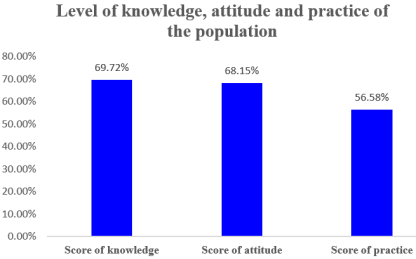
Cumulative score | 69.72% |
Subcomponent of Attitude | Item Evaluated | % of Correct Answers |
|---|---|---|
Risk Perception | The Mpox is a risk to my community | 78.50% |
Acceptance of the Measures | Isolation in case of illness | 72.10% |
I would agree to be vaccinated if available | 81.30% | |
Intention to report | I would report a suspected case to the authorities. | 88.00% |
Stigmatization | Cases of Mpox should not be stigmatized | 49.90% |
Disagreed that "People who have been in contact with others should be avoided". | 39.10% | |
Cumulative score | 68.15% |
Subcomponent of Practices | Item Evaluated (Reported Practice) | % of Positive Responses |
|---|---|---|
Hygiene | Wash your hands frequently with soap | 76.80% |
Avoiding the sharing of personal items | 61.10% | |
Animal/Food Behavior | Avoid raw/undercooked bushmeat | 35.60% |
Avoid handling dead or sick animals | 48.00% | |
Care Search | Consult a doctor immediately if a skin rash develops. | 65.30% |
Use of a hospital/health center | 52.70% | |
Cumulative score | 56.58% |
Covariates | Score of knowledge | Score of attitudes | Score of practice | ||||||
|---|---|---|---|---|---|---|---|---|---|
Coefficient | 95% CI | p-Value | Coefficient | 95% CI | p-Value | Coefficient | 95% CI | p-Value | |
Constant | 56.20 | 53.46 | 47.14 | ||||||
Age (in year) | NA | - | 1.65 | 1.09-2.50 | 0.017 | NA | - | - | |
Female gender | NA | - | - | NA | - | - | 1.62 | 1.11; 2.37 | 0.012 |
Higher Education Level | 3.22 | 1.98; 5.24 | 0.007 | NA | - | - | NA | - | - |
Media Access | 1.95 | 1.19; 3.21 | 0.009 | NA | - | - | NA | - | - |
Good knowledge | NA | - | - | 1.88 | 1.26; 2.80 | 0.002 | NA | - | - |
Good attitude | NA | - | NA | - | - | 2.85 | 1.97; 4.13 | 0.0001 | |
Farming/livestock farming profession | NA | - | - | NA | - | - | - 0.35 | -0.74; -0.22 | 0.0001 |
Residence in a rural area | NA | - | - | NA | - | - | -0.59 | -0.81; -0.37 | 0.005 |
MPOX | Monkeypox |
KAP | Knowledge, Attitudes, and Practices |
WHO | World Health Organization |
CDC | Centers for Disease Control and Prevention |
SD | Standard Deviation |
CI | Confidence Interval |
| [1] | Petersen E, et al. Human monkeypox: a review of current knowledge and future research directions. Clin Infect Dis. 2019; 69(Suppl_2): S341-S347. |
| [2] | Rimoin AW, et al. Major increase in human monkeypox incidence in the Democratic Republic of Congo. Proc Natl Acad Sci. 2010; 107(37): 16262-16267. |
| [3] | Thornhill JP, et al. Monkeypox Virus Infection in Humans across 16 Countries — April–June 2022. N Engl J Med. 2022; 387(18): 1709-1721. |
| [4] |
World Health Organization (WHO). Multi-country outbreak of monkeypox, 2022. Available at:
https://www.who.int/emergencies/disease-outbreak-news/item/2022-DON409 |
| [5] | Durski KN, et al. Clinical Cases for an Unprecedented Outbreak of Human Monkeypox in a Non-endemic Setting – The United States, 2003. Am J Trop Med Hyg. 2018; 99(2): 295-300. |
| [6] | McCollum AM, et al. Monkeypox: state of knowledge and implications for research. Lancet Infect Dis. 2014; 14(1): 7-15. |
| [7] | Junaid Y, et al. Retrospective review of confirmed human monkeypox cases in Nigeria, 2017-2020. Int J Infect Dis. 2021; 102: 115-121. |
| [8] | Fagbemi KM, et al. Genomic surveillance of Monkeypox virus in Nigeria: implications for the 2022 global outbreak. Virol J. 2023; 20: 105. |
| [9] | Nkengasong JN. Africa CDC: Adapting to new threats. N Engl J Med. 2020; 382(2): 112-114. |
| [10] | Adekunle AA, et al. Bushmeat consumption patterns and public health implications in Benin. Trop Anim Health Prod. 2021; 53: 1-10. |
| [11] | Alimi ES, et al. Socio-cultural practices and transmission of zoonotics diseases in rural Nigeria. J Infect Public Health. 2019; 12(4): 543-548. |
| [12] | Launiala A. How to use the KAP model in health research. Health Promot Int. 2005; 20(3): 321-326. |
| [13] | Mupela JD, et al. Knowledge, attitudes and practices regarding COVID-19 in Lusaka, Zambia: a community-based study. BMC Public Health. 2021; 21: 150. |
| [14] | Shittu RO, et al. Psychological impacts of monkeypox outbreak: a cross-sectional study of fear, anxiety, and perceived stigma in a Nigerian population. Pan Afr Med J. 2023; 44: 116. |
| [15] | Onyekachi MO, et al. Knowledge and perception of infectious diseases outbreaks among residents of a rural community in Southeast Nigeria. J Public Health Afr. 2020; 11(3): 1279. |
| [16] | Gbeasor JE, et al. Health literacy and utilization of public health information among vulnerable populations in West Africa. Int Q Community Health Educ. 2024; 44(2): 185-197. |
| [17] | Hampson K, et al. Pervasive urban poverty and the challenge of sustaining public health efforts for zoonotics disease control in Africa. Philos Trans R Soc B. 2018; 373(1750): 20170094. |
| [18] | Osabohien R, et al. Socio-economic drivers of health outcomes in Sub-Saharan Africa. Afr Health Sci. 2022; 22(1): 108-118. |
| [19] | Adedotun BJ, et al. Knowledge, attitudes, and practices regarding monkeypox among primary healthcare workers in Ibadan, Nigeria. BMC Public Health. 2023; 23: 2011. |
| [20] | Sow IO, et al. Evaluation of knowledge and preventive practices against Lassa fever in Guinea. Trop Med Int Health. 2019; 45(2): 158-164. |
| [21] | Abiodun OO, et al. Determinants of prevention behaviors against infectious diseases in low-income settings in Ibadan, Nigeria. Afr J Prim Health Care Fam Med. 2022; 14(1): a3479. |
| [22] | Nkwenti ME, et al. Community engagement strategies for epidemic control in Cameroon: lessons from past outbreaks. J Public Health Afr. 2020; 11(3): 1198. |
| [23] | Ndiaye B, et al. Public health communication strategies in sub-Saharan Africa. Public Health. 2018; 30(2): 221-230. |
| [24] | Kouamé KM, et al. Impact of rumors and disinformation on the response to epidemics in Côte d'Ivoire. Afr Sci J Public Health. 2023; 2(1): 45-56. |
| [25] | Diallo AB, et al. Role of traditional healers and community leaders in health crisis management in Mali. Afr J Prim Health Care Fam Med. 2024; 16(1): a4010. |
| [26] | Bandura A. Social Cognitive Theory: An Agentic Perspective. Asian J Soc Psychol. 1999; 2(1): 21-41. |
| [27] | Ajayi GO, et al. Poverty, environmental changes and risk of emerging zoonoses in Sub-Saharan Africa. Emerg Infect Dis. 2018; 24(9): 1601-1607. |
| [28] | Glick HA, et al. Cost-effectiveness of public health interventions in low- and middle-income countries: a systematic review. Cost Eff Resour Alloc. 2020; 18: 5. |
| [29] | Olowu OA, et al. Gender differences in knowledge, attitude, and practice regarding sanitation and hygiene among rural communities in Ogun State, Nigeria. Int J Environ Res Public Health. 2021; 18(11): 5857. |
| [30] | World Health Organization (WHO). Global strategy for prevention and control of MPOX: Addressing the future of orthopoxviruses. WHO Publications; 2024. |
APA Style
Romeo, P. S. G., Colette, A., Romeo, A., Jennifer, O., Badirou, A. (2025). Knowledge, Attitudes and Prevention Practices of the Populations of Tchaourou and Parakou (Benin) Regarding Monkeypox. Science Journal of Public Health, 13(6), 369-375. https://doi.org/10.11648/j.sjph.20251306.16
ACS Style
Romeo, P. S. G.; Colette, A.; Romeo, A.; Jennifer, O.; Badirou, A. Knowledge, Attitudes and Prevention Practices of the Populations of Tchaourou and Parakou (Benin) Regarding Monkeypox. Sci. J. Public Health 2025, 13(6), 369-375. doi: 10.11648/j.sjph.20251306.16
AMA Style
Romeo PSG, Colette A, Romeo A, Jennifer O, Badirou A. Knowledge, Attitudes and Prevention Practices of the Populations of Tchaourou and Parakou (Benin) Regarding Monkeypox. Sci J Public Health. 2025;13(6):369-375. doi: 10.11648/j.sjph.20251306.16
@article{10.11648/j.sjph.20251306.16,
  author = {Padonou Setondji Geraud Romeo and Azandjeme Colette and Adegbite Romeo and Olofindji Jennifer and Aguemon Badirou},
  title = {Knowledge, Attitudes and Prevention Practices of the Populations of Tchaourou and Parakou (Benin) Regarding Monkeypox},
  journal = {Science Journal of Public Health},
  volume = {13},
  number = {6},
  pages = {369-375},
  doi = {10.11648/j.sjph.20251306.16},
  url = {https://doi.org/10.11648/j.sjph.20251306.16},
  eprint = {https://article.sciencepublishinggroup.com/pdf/10.11648.j.sjph.20251306.16},
  abstract = {Introduction: Monkeypox is a re-emerging viral zoonosis that poses a serious threat to public health, particularly in West Africa. A precise understanding of the Knowledge, Attitudes, and Practices (KAP) of the population is essential for designing effective community-based responses. This study aimed to assess the level of KAP in the population and to identify factors independently associated with good KAP. Methods: A cross-sectional, descriptive, and analytical study was conducted in Tchaourou and Parakou, in the Borgou department of Benin, between February and April 2025. A total of 427 people were included. Cumulative scores for knowledge, attitudes, and preventive practices regarding monkeypox were calculated. Three linear regression models were used to identify factors associated with good knowledge, attitudes, and practices. Results: Mean score of knowledge was 56.0%, mean score of attitude 67.0%, and mean score of practice only 44.3%. Factors significantly associated with an increase in the level of knowledge were higher education level (coefficient = 3.22; 95% CI: [1.98; 5.24]) and access to media (coefficient = 1.95; 95% CI: [1.19; 3.21]). Positive attitude was related to good knowledge (coefficient = 1.88; 95% CI: [1.26; 2.80]) and age (coefficient = 1.65; 95% CI: [1.09–2.50]). Regarding good practices, a positive attitude (coefficient = 2.85; 95% CI: [1.97; 4.13]) and female sex (coefficient = 1.62; 95% CI: [1.11; 2.37]) were significant predictors. Conversely, being a farmer/livestock breeder (coefficient = -0.35; 95% CI [-0.74; -0.22]) and living in a rural area (coefficient = -0.59; 95% CI [-0.81; -0.37]) were associated with poor practices. Conclusion: Although the overall attitude is relatively positive, this study reveals significant gaps in knowledge and, especially, in the adoption of effective preventive practices. Targeted interventions are recommended, including the use of communication channels adapted to low-education populations and communication strategies for behavioral change.},
 year = {2025}
}
TY  - JOUR
T1  - Knowledge, Attitudes and Prevention Practices of the Populations of Tchaourou and Parakou (Benin) Regarding Monkeypox
AU  - Padonou Setondji Geraud Romeo
AU  - Azandjeme Colette
AU  - Adegbite Romeo
AU  - Olofindji Jennifer
AU  - Aguemon Badirou
Y1  - 2025/12/29
PY  - 2025
N1  - https://doi.org/10.11648/j.sjph.20251306.16
DO  - 10.11648/j.sjph.20251306.16
T2  - Science Journal of Public Health
JF  - Science Journal of Public Health
JO  - Science Journal of Public Health
SP  - 369
EP  - 375
PB  - Science Publishing Group
SN  - 2328-7950
UR  - https://doi.org/10.11648/j.sjph.20251306.16
AB  - Introduction: Monkeypox is a re-emerging viral zoonosis that poses a serious threat to public health, particularly in West Africa. A precise understanding of the Knowledge, Attitudes, and Practices (KAP) of the population is essential for designing effective community-based responses. This study aimed to assess the level of KAP in the population and to identify factors independently associated with good KAP. Methods: A cross-sectional, descriptive, and analytical study was conducted in Tchaourou and Parakou, in the Borgou department of Benin, between February and April 2025. A total of 427 people were included. Cumulative scores for knowledge, attitudes, and preventive practices regarding monkeypox were calculated. Three linear regression models were used to identify factors associated with good knowledge, attitudes, and practices. Results: Mean score of knowledge was 56.0%, mean score of attitude 67.0%, and mean score of practice only 44.3%. Factors significantly associated with an increase in the level of knowledge were higher education level (coefficient = 3.22; 95% CI: [1.98; 5.24]) and access to media (coefficient = 1.95; 95% CI: [1.19; 3.21]). Positive attitude was related to good knowledge (coefficient = 1.88; 95% CI: [1.26; 2.80]) and age (coefficient = 1.65; 95% CI: [1.09–2.50]). Regarding good practices, a positive attitude (coefficient = 2.85; 95% CI: [1.97; 4.13]) and female sex (coefficient = 1.62; 95% CI: [1.11; 2.37]) were significant predictors. Conversely, being a farmer/livestock breeder (coefficient = -0.35; 95% CI [-0.74; -0.22]) and living in a rural area (coefficient = -0.59; 95% CI [-0.81; -0.37]) were associated with poor practices. Conclusion: Although the overall attitude is relatively positive, this study reveals significant gaps in knowledge and, especially, in the adoption of effective preventive practices. Targeted interventions are recommended, including the use of communication channels adapted to low-education populations and communication strategies for behavioral change.
VL  - 13
IS  - 6
ER  -
Department of Public Health, University of Abomey-Calavi, Cotonou, Republic of Benin
Regional Institute of Public Health, University of Abomey-Calavi, Ouidah, Republic of Benin
Department of Infectious Diseases, Lambarene Medical Research Center, Lambarene, Gabon
Faculty of Health Sciences, University of Abomey-Calavi, Cotonou, Republic of Benin
Department of Public Health, University of Abomey-Calavi, Cotonou, Republic of Benin



 Share This Article
 Twitter
 Linked In
 Facebook
 Copy
Copy Download